We are still in the process of discussing Publication Launch Celebration, so here are some of my ideas:
Make posters and put them on social media
Contact part of students and tutors, give them publication early and get reviews
We also discussed ideas such as we might all carry our physical publication in case of when any audiences want to understand more, we can use it to explain and have conversation with the audiences, we can also ask the audiences how does she or he think about her or his identity in relationship with her or his surrounding as well similar to an interview.
This is the schedule of our group’s work. Basically we divide the task into digital, print and digital creation.
What does it mean to be a ‘self’ in this world? In this publication, we pose that question and explore what it means to us. The works in this publication reflect our thinking surrounding this topic, starting out with questioning ‘the self’ through works that:
· explore an entity’s relationship with objects, and how this shapes it’s being, and
· build a quasi-profile of a person’s identity, to question the relationship between displayed or selected identity and if this is indeed true.
Through this investigation, questions begin to emerge: Who am I? What am I? Who are we? What are we? We offer the reader to the opportunity to ponder these questions, as they consider our work.
The second part of this publication is an exploration of how ‘the self’ perceives its surroundings and how, in turn, this perception influences ‘the self’, the surroundings being physical space, both human-made and natural. The surroundings get drawn out through the perception of light, sound and motion, and the corruption of it through illusions.
Through this investigation, questions begin to emerge: What are you? What shapes you? What is and is not real?
The last part ponders upon the larger metaphysical world of life and death and everything in-between. The ceaseless grip of death on ‘the self’ shapes and contextualises our lives, but is there a way for one’ self’ to escape it, potentially into a digital world?
Through this investigation, questions begin to emerge: Is there even a self without a physical surrounding? Could this disembodiment be a higher form a ‘self’ can achieve? Can the digital have a soul?
The goal of our publication is to journey outwards and inwards into the notion of ‘the self’.
Modern human, live in two spaces, one is the physical layer of the so-called real world, and the other is the virtual layer of the so-called network world. What exists on the physical level is the human body; What lives on the virtual level is the human soul. The soul is built on the material foundation of the body, and disappear with the ageing and death of the body. That is why any religion would put forward “immortal”, “eternal”. And to get what’s called “immortality,” “eternity,” you have to achieve some kind of “transcendence”.
We have long held that the human soul is superior to matter or can be separated from matter in some form. Because today’s human society is completely based on the structure of physics, everything can be explained by physics, but the human soul cannot be explained by physics.
Nowadays, the highly developed technology has finally materialized the immaterial human consciousness, and brain memories are stored, copied, migrated and modified through information technology. The elusive soul has been informationized and digitized, born in the virtual space of the computer network. Could this be the point at which we reach ” transcendence” and obtain “immortality” and “eternity”?
In my opinion, the development of AI technology gives humans the opportunity to break out of the physical cage and become data creatures.I put my thoughts into a poem and expressed it in various forms.
Digital data, with its greater volume and regularity, is reminiscent of DNA sequence. A whole new form of life seems to be in the making. Humans and data also make interesting visual differences when they present the same content.
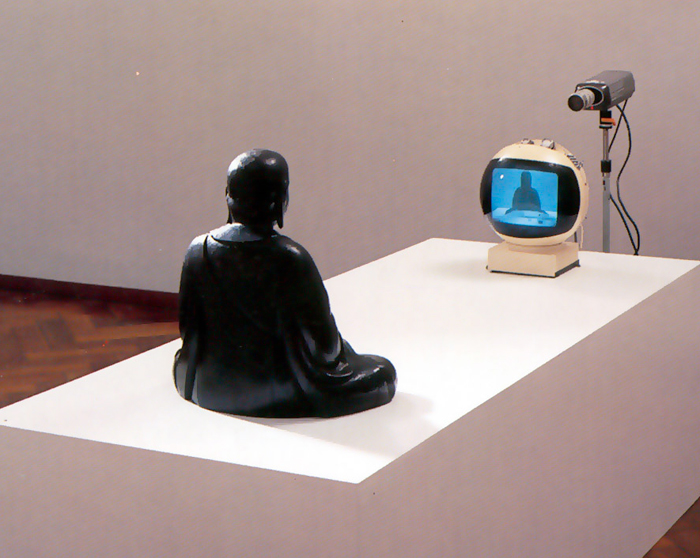
There are interesting visual differences between classical and technological objects. Nam June Paik is an expert on this subject. combining the imagine of buddha with a screen, which inspires the philosophical thought.
Religion and science, two aspects of the development of human civilization, are means of exploring the unknown and inevitably intertwined. Humanbeings who believes in the creator is also the creator themselves. We have created an infinite world of data. The zero and one are just like the good and evil of Christianity and the Yin and Yang of Taoism, maintaining order in that world.
I used the head of the Dying Slave by Michelangelo. The original work symbolizes a soul struggle against the bonds of temptation and sin. I wound it up with multiple data cables, which symbolized that this soul is going to wake up from the data world.
In this work, the Buddha is a symbol of meditation and enlightenment, while placing it opposite the television and camera is a symbol of modern technology. As a lifelong buddhist, paik used this work to question the role of the self in an age that intersects with spirituality and technology.
Each piece in the series consists of a Buddha sitting opposite the camera and the television. Through the projection of the camera, the Buddha gazes at his own image on the television screen, raising questions of ego and humanity in a constant eye-to-eye contest.
Religion and science, two aspects of the development of human civilization, are means of exploring the unknown and inevitably intertwined. Humanbeings who believes in the creator is also the creator themselves. We have created an infinite world of data. The zero and one are just like the good and evil of Christianity and the Yin and Yang of Taoism, maintaining order in that world.
During the 1930s, Dora Maar’s provocative photomontages became celebrated icons of surrealism.
Her eye for the unusual also translated to her commercial photography, including fashion and advertising, as well as to her social documentary projects. In Europe’s increasingly fraught political climate, Maar signed her name to numerous left-wing manifestos – a radical gesture for a woman at that time.
Her relationship with Pablo Picasso had a profound effect on both their careers. She documented the creation of his most political work, Guernica 1937. He painted her many times, including Weeping Woman 1937. Together they made a series of portraits combining experimental photographic and printmaking techniques.
In middle and later life Maar withdrew from photography. She concentrated on painting and found stimulation and solace in poetry, religion, and philosophy, returning to her darkroom only in her seventies.
This exhibition will explore the breadth of Maar’s long career in the context of work by her contemporaries.




 shengye.home.blog